

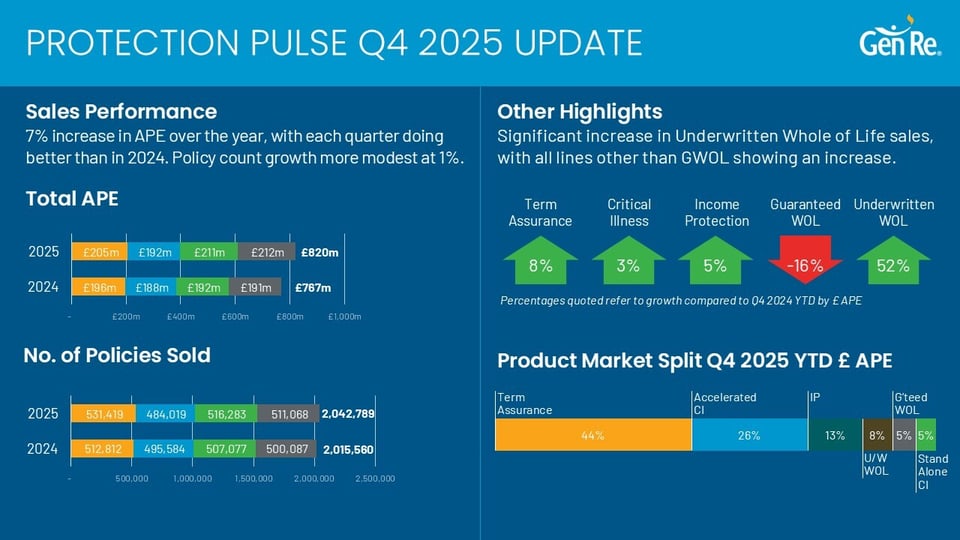
It has been an exceptional year for Protection sales: premium volumes, as measured by the annual premium equivalent (APE), have increased by 7% and there have been some stellar performances within some product lines. In addition, the last two quarters of 2025 witnessed the highest recorded level of APE sales in our Protection Pulse dataset. With data going back to 2011, this has been quite a momentous year for sales.
The growth in the number of policies sold was more modest, at just 1%. This has resulted in an increase in the average level of premium per policy sold.
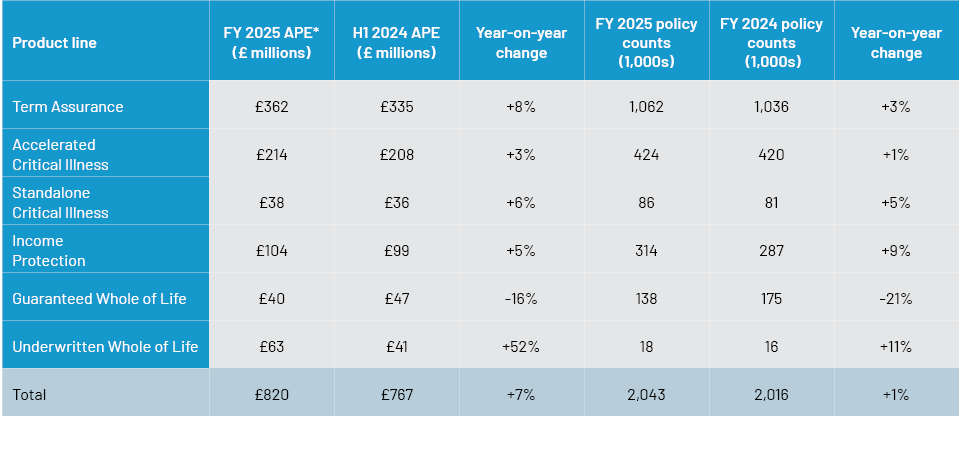
The following table shows the performance by product line.
Table 1: FY 2025 performance by product line
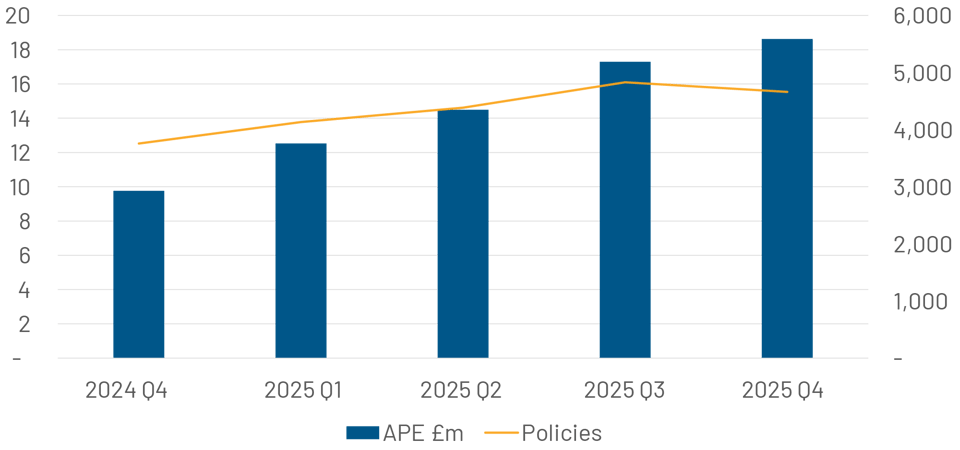
The star of the show was undoubtedly the Underwritten Whole of Life product. APE for this increased by a staggering 52% over the year, with the number of policies sold up by 11%. Quarter on quarter there was some remarkable premium growth, with each quarter demonstrably better than the last, as can be seen by the following chart.
Figure 1: Underwritten Whole of Life Sales
A number of factors are driving this significant growth, with UK Inheritance Tax (IHT) planning a key driver. Agricultural Property Relief (APR) and Business Property Relief (BPR) reforms are due to come into effect in April 2026,1 and further down the line in April 2027 pensions will also come into scope of IHT.2 It is clear that the combination of these is driving individuals to take action. With premium growth far larger than the growth in the number of policies sold, it indicates that individuals are taking out ever larger policies.
We think that there is likely to be further, significant growth in this area too, although there is a possibility that this is tempered by the product’s dependency on the economic outlook, in particular interest rates. These have a direct impact on the cost of the product, which then has an impact on its desirability and affordability.
In complete contrast with the underwritten product, sales of Guaranteed Whole of Life policies have really struggled: APE is down 16% and policy count is down 21%. A significant factor behind this reduction is the ongoing Pure Protection Market Study by the UK Financial Conduct Authority (FCA), with one of the focus areas of this study concerning whether guaranteed acceptance over 50s insurance offers fair value.3 It is likely that this has led to firms easing off the marketing spend, which in turn reduces the level of sales.
In January the FCA produced its interim report,4 which concluded that no action is necessary at this stage.5 It also noted that the products filled a particular niche in the market and that there was a considerable protection gap. However, it remains to be seen whether this provides enough certainty for providers to “turn on the taps” again, with respect to marketing spend, or whether they will wait for the final report – due in Q3 2026 – before taking more definitive action.
Term Assurance sales in 2025 were 8% higher in APE terms and 3% higher by policy count, compared to 2024. This has reversed three straight years of slight decline. Each quarter in 2025 did better than the respective quarter in 2024, and for the first time in our Protection Pulse data, there were three quarters with APE above £90 million; typically, we may see one quarter in a year where sales have exceeded £90 million.
The growth seems to be driven by the mortgage market, with our data showing an increase in term assurance being used to protect mortgages. The FCA’s mortgage lending statistics also show a substantial increase in mortgage advances: Q3 2025 was 23% higher than Q3 2024.6 This, coupled with rising property values,7 would lead to a greater demand for Protection.
Replicating the turnaround seen for mortality, although at a reduced level, Accelerated Critical Illness has recorded a growth in both APE (3%) and policies sold (1%), turning around a contraction that started in the COVID-19 years. Volumes are still markedly down compared to its peak, but it is pleasing to see that a corner may have been turned for a product that provides a more comprehensive level of cover for the customer.
Standalone Critical Illness has continued to grow, albeit at a slower rate compared to previous years: 2025 showed APE growth of 6% and a policy growth of 5%. The apparent slowdown did not prevent H1 and H2 both being half-year records of sales – a run that now stretches back eight successive half-year periods to when sales patterns were impacted by COVID-19. Given this growth, we expect there to be at least one quarter in 2026 where APE will exceed £10 million. This would be quite remarkable for a product that in 2015 had less than £10 million of APE sales across the year and accounted for less than 4% of Critical Illness policies sold; today it accounts for over 15%.
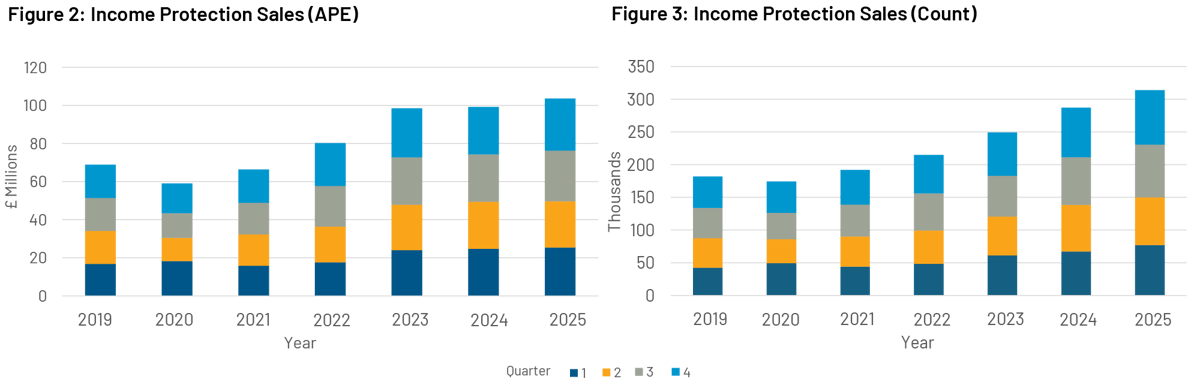
Finally, Income Protection (IP) continues to grow. In contrast to the other product lines, the APE growth was less than the growth in policies sold, with APE up 5% and policy count up 8% compared to 2024. This continues what was seen in 2024, and continues a pattern of reducing average premium size by policy. To demonstrate the different growth rates over time, we have the following two charts.
We think that there is likely to be a number of drivers behind this trend, with three of the major contributors being:
- Increased engagement from younger customers who may be likely to take out policies with lower sums assured than those in the older age group to whom insurers have traditionally sold IP policies;
- The rise in the number of customers purchasing IP cover via menu plans; and
- A shift over recent years with customers seeking a “budget” product, with a benefit paid over a limited period, rather than to retirement.
A collaboration between IPTF and Iress produced a report entitled the ‘Profile of an IP Customer’.8 It was noted that nearly half of all IP policies are now sold as part of a menu plan. It also noted that clients with a menu plan are more likely to select comprehensive IP, often extending to retirement, but the average cover amount is lower compared to standalone IP policies. This change in purchasing habits could negate slightly the recent trend towards budget products.
The outlook for 2026
As ever, life insurers face a range of evolving challenges, trends and opportunities that could reshape their business landscape. With the first big set of IHT changes taking effect in April 2026, we should continue to see an increased demand for Underwritten Whole of Life policies. The conclusion of the FCA’s Pure Protection Market Study could have an impact on the Guaranteed Whole of Life markets, and we expect to see continued growth in Income Protection and Standalone CI. Look out for our quarterly Protection Pulse updates in 2026!

Endnotes
1, Agricultural property relief and business property relief reforms. Published 21 July 2025 https://www.gov.uk/government/publications/reforms-to-agricultural-property-relief-and-business-property-relief/agricultural-property-relief-and-business-property-relief-reforms
2. Inheritance Tax on unused pension funds and death benefits. Published 21 July 2025 https://www.gov.uk/government/publications/reforming-inheritance-tax-unused-pension-funds-and-death-benefits/inheritance-tax-on-unused-pension-funds-and-death-benefits
3. FCA Press Release ‘FCA announces work into pure protection market.’ Published 28 October 2024. https://www.fca.org.uk/news/press-releases/fca-announces-work-pure-protection-market
4. FCA interim report. Market study into the distribution of pure protection products to retail customers. Published 16 January 2026 http://www.fca.org.uk/publication/market-studies/ms24-1-4-market-study-distribution-pure-protection-products-retail-customers-interim-report.pdf
5. FCA Mortgage Lending Statistics to Q3 2025. Published 9 December 2025. https://www.fca.org.uk/data/commentary-mortgage-lending-statistics-q3-2025
6. Ibid, see endnote 5
7. UK Government Price Index for June 2025. Published 20 August 2025. https://www.gov.uk/government/news/uk-house-price-index-for-june-2025
8. IPTF and Iress – Profile of an IP Customer: Evolving The Profile. Published September 2025. https://iptf.co.uk/wp-content/uploads/2025/09/Profile-of-an-IP-customer-Evolving-the-Profile.pdf
Disclaimer
The contents of this Protection Pulse market summary are observations made by Gen Re based upon information available at the time. This report does not constitute professional advice and recipients should seek their own advice if they consider it necessary to do so. Gen Re assumes no liability whatsoever for the contents of this report or any reliance placed upon its contents by a recipient.
This report is the copyright of Gen Re and may not be reproduced and distributed without the express permission of Gen Re.
While we don’t expect these results to change materially, they are subject to revision pending final data receipt.