

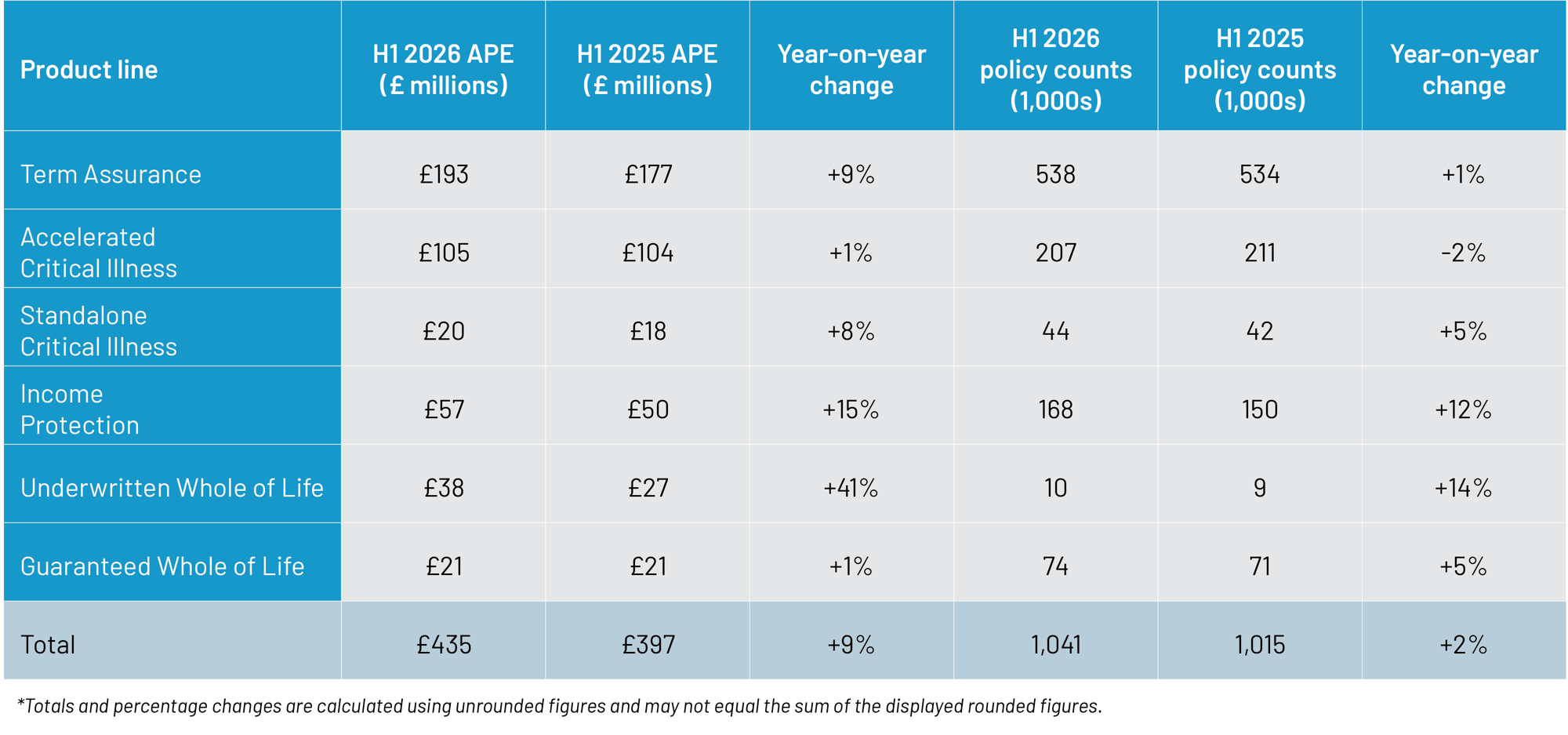
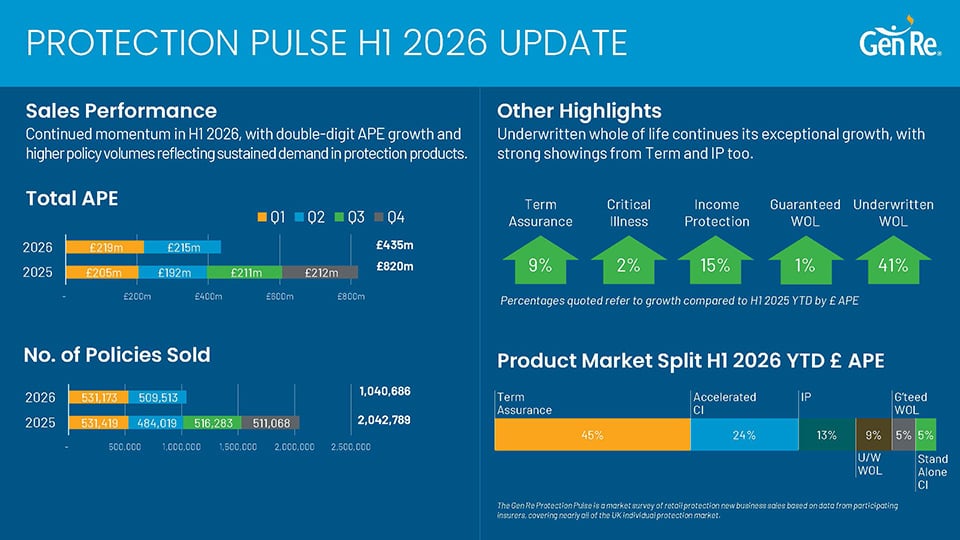
The UK protection market has delivered another record half-year, with the H1 2026 annual premium equivalent (APE) up 9% year on year and the latest two quarters reaching the highest sales levels recorded in our Protection Pulse dataset, going back to 2011. It has been an exceptional start to the year.
By contrast, policy counts have shown more modest growth, rising by a steady 2% year-on-year, in line with the long-term average growth.
Table 1: H1 2026 performance by product line
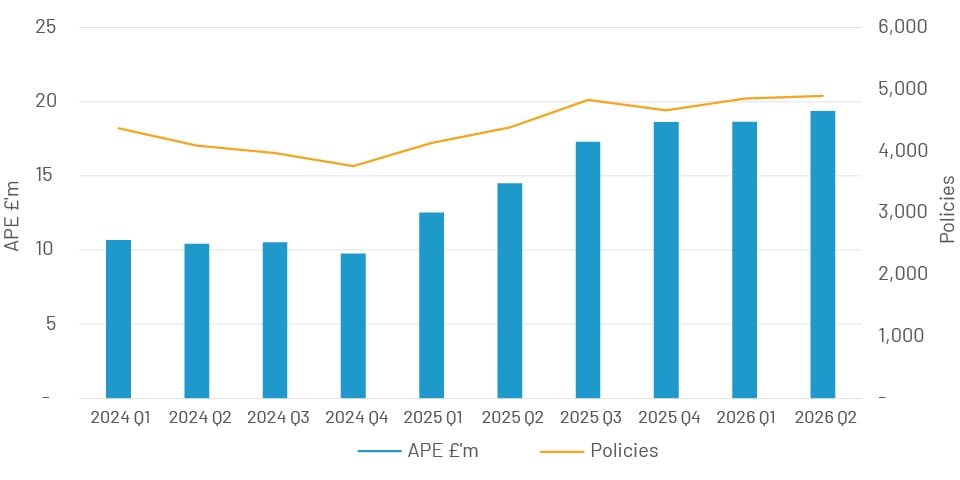
Underwritten Whole of Life continues to be the standout performer, with APE increasing by 41% year-on-year. While growth remains exceptionally strong, the quarterly data suggests that the rapid expansion seen through 2025 has begun to stabilise, with APE around £19m per quarter during H1 2026. This follows a period of particularly strong growth, during which inheritance-tax changes have brought increased attention to Whole of Life as an estate-planning solution.
Underwritten Whole of Life sales from Q1 2024 to Q2 2026
The APE for Guaranteed Whole of Life remains broadly in line with the 2025 position, with growth of just 1%. This stabilisation in sales coincided with the UK Financial Conduct Authority’s (FCA) interim market study report on the distribution of pure protection products.1 The report, released in January 2026, concluded that no action was likely to be necessary in relation to the Over 50s market, and it also recognised that this product served those consumers who may not be able, or choose not to, access underwritten insurance. It will be interesting to see what impact the recently published final report may have on the market and whether this will drive sales up.
Income Protection has continued its growth trajectory and has recorded a 15% increase in APE and a 12% increase in policy count. Greater awareness of the product may support further growth, although the trajectory will depend on wider market and economic conditions.
Another product line continuing its strong growth is Standalone Critical Illness, which recorded APE growth of 8% and a policy count growth of 5%. By contrast, sales of Accelerated Critical Illness cover remained subdued. We had hoped that this may have turned a corner at the end of 2025, but performance in the first half of the year has been muted: APE growth remained broadly flat, at just under 1% and policy count has declined by 2%. The overall impact of this is that the combined Critical Illness product lines recorded APE growth of 2%, while policy count declined by 0.7%.
Finally, Term Assurance, which accounts for more than half of all protection policies written, also performed strongly in the first half of the year. APE increased by 9%, while policy count increased by just 1%, indicating strong growth in average premiums.
The Outlook for H2 2026
Despite the evolving trends across individual product lines, the sustained strong growth in Term Assurance and Income Protection provides a positive backdrop for the protection market entering H2. However, wider economic conditions remain an important consideration. Household affordability could constrain growth in policy volumes. Mortgage market activity and the significant protection gap also provide opportunities for further growth. As ever, Gen Re will continue to share insights from the UK protection market and highlight any emerging trends.

Endnotes
1. FCA interim report. Market study into the distribution of pure protection products to retail customers. Published 29 January 2026, http://www.fca.org.uk/publication/market-studies/ms24-1-4-market-study-distribution-pure-protection-products-retail-customers-interim-report.pdf
Disclaimer
The contents of this Protection Pulse market summary are observations made by General Reinsurance based upon information available at the time. This report does not constitute professional advice and recipients should seek their own advice if they consider it necessary to do so. Gen Re assumes no liability whatsoever for the contents of this report or any reliance placed upon its contents by a recipient.
This report is the copyright of Gen Re and may not be reproduced or distributed without the express permission of Gen Re.
While we don’t expect these results to change materially, they are subject to revision pending final data receipt.